
Building for permanence in an industry built on disposability.
The industry runs on volume: thousands of interchangeable titles a year, the same loops wearing different skins. Working the other way: a small number of games, each recognisable from across a room.
A game that works needs no ornament. Most of the work is taking things away, until what remains is only what the player came for.
Every mechanic starts from one question: what is happening in a player’s head at the moment of a decision? Not the mathematics. The feeling: the hesitation, the nerve, the quiet negotiation before a choice is made.
That moment is the game. Everything else is packaging.
How Walkaway builds.
Fewer games. Greater impact.
The market rewards volume, so volume is what it gets: interchangeable releases, forgotten in weeks. Taking the opposite path: a small number of titles, each built to be recognised instantly and remembered afterwards.
One clear concept.
Every game begins as one compelling idea, stated in a single sentence. Features earn their place only when they sharpen that sentence, and get cut when they blur it. If the core can’t be explained in a line, it isn’t ready to be built.
Built like a tech company, crafted like a games studio.
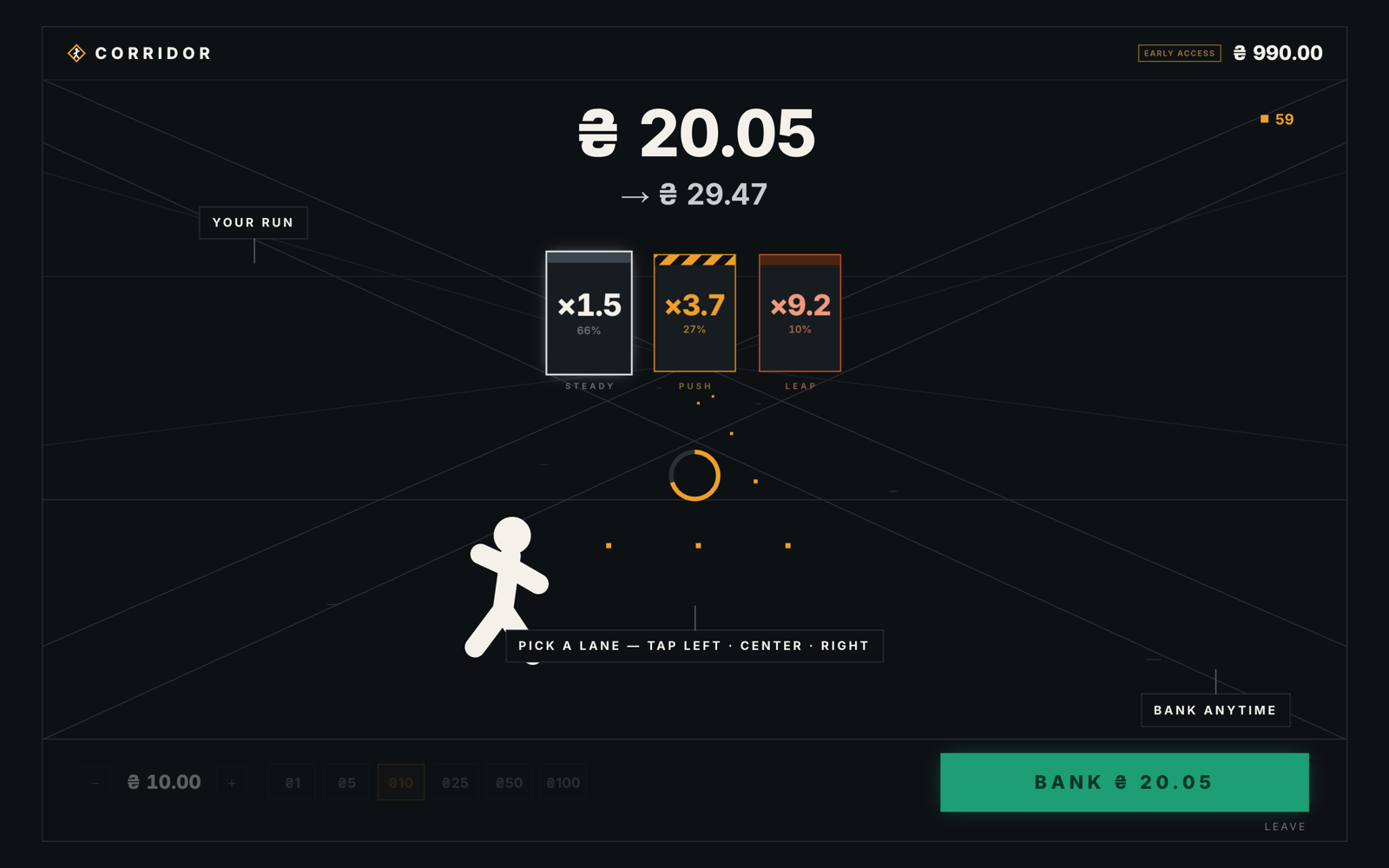
In most of this industry a game is designed, built, certified, and only then played. Certification freezes the design, so the first honest player feedback arrives exactly when change is slowest and most expensive. That cost structure is why almost nobody experiments: iteration after certification costs too much, and iteration before it requires infrastructure most suppliers never build. Working in the opposite order instead: releasing concepts as free demos, measuring how real players behave, iterating while iteration is cheap, and sending a design to certification only once it has proven itself. Building on proof, never on assumption.
Walkaway Studio designs and builds games for the iGaming industry. Founded 2026.